


If you're shopping for an RV garage home in Southern Utah, you already know the problem. Listings throw around terms like "RV garage," "extended bay," and "toy hauler garage" without much consistency. One seller's 40-foot RV garage is another buyer's disappointment once you show up with a tape measure and find a water heater closet eating three feet off the back wall.
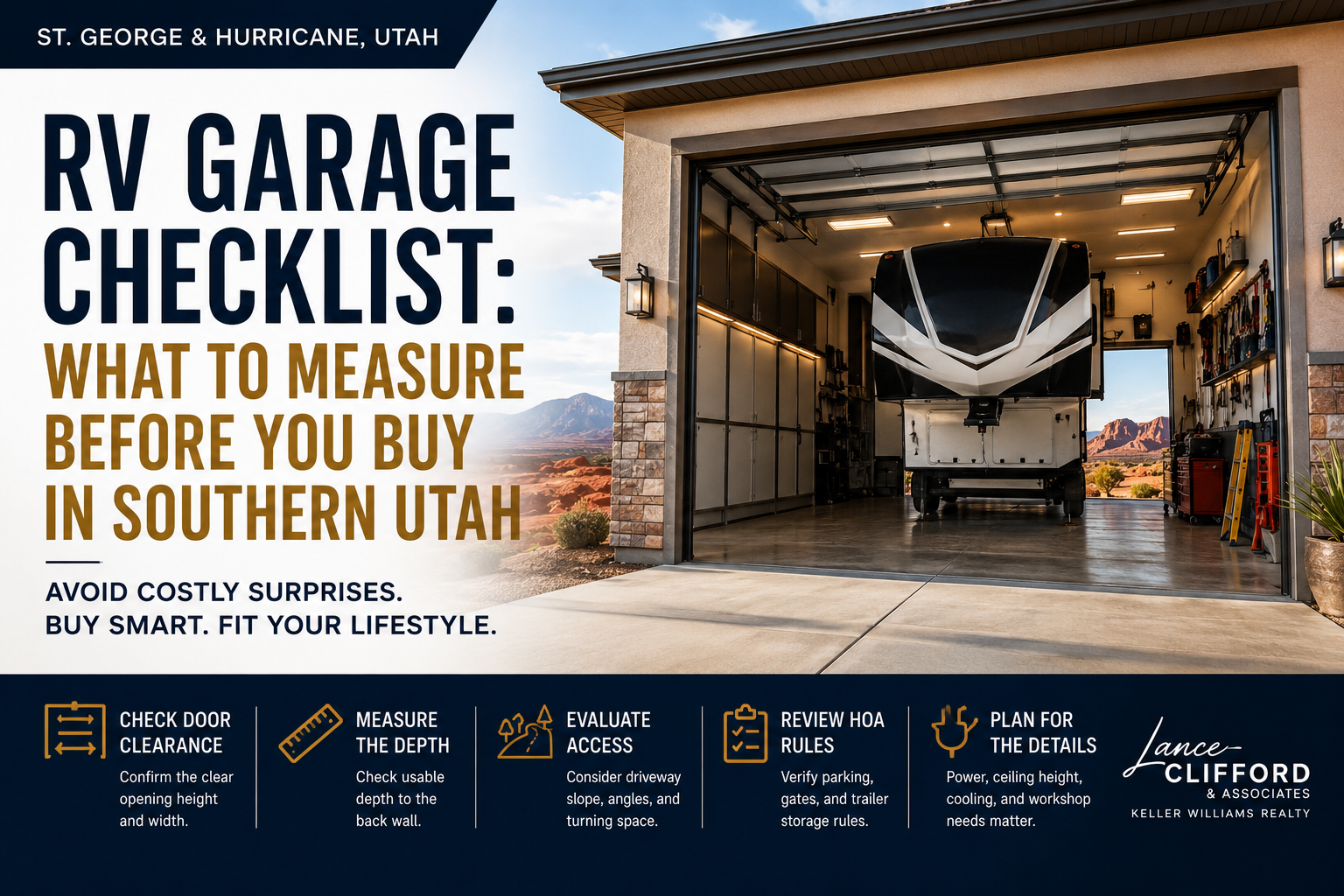
I've walked through a lot of these garages with buyers. The checklist below is what I actually use. It takes about five minutes on-site and prevents most of the surprises that show up after closing.
Browsing first? Start with RV Garage Homes for active inventory, or use Advanced Search to filter by city, price, and features. When you find something promising, use this checklist before you make an offer.
Quick reference: minimum clearances by rig type
Before we get into the checklist, here's the number most buyers need first. Your rig drives the minimum specs. Everything else flows from there.
| Rig Type | Typical Height (with A/C) | Minimum Door Height I'd Want | Minimum Depth |
|---|---|---|---|
| Class A motorhome | 11'6" – 13'6" | 14' (clear opening, not door size) | 40 – 45 ft usable |
| Class C motorhome | 10'6" – 12' | 12' – 13' clear opening | 35 – 40 ft usable |
| Fifth wheel | 12'6" – 13'6" | 14' clear opening | 40 – 50 ft (truck + trailer) |
| Travel trailer | 9'6" – 11'6" | 12' clear opening | 30 – 40 ft usable |
| Toy hauler | 12' – 13'6" | 13' – 14' clear opening | 38 – 45 ft usable |
| Boat on trailer | Varies widely | Measure your rig + 12" buffer | Beam length + 6 ft |
These are starting points, not guarantees. Always measure your specific rig with everything on the roof: A/C units, solar panels, racks, antennas. Then add at least six inches of buffer on height.
The on-site checklist
1. Door height vs. clear opening height: they're not the same number
A listing that says "12-foot door" is telling you the door size. What actually matters is the clear opening height after the door is fully open. Tracks, the opener motor housing, and header framing all eat into that number. In some installs it's only a few inches of difference. In others it's six to eight inches.
Measure from the floor to the lowest point of the fully-open door assembly, not the door itself. That's your real clearance. If there's any question about fit, I want a minimum of six inches of buffer between your rig's tallest point and that opening.
2. Usable depth: measure twice, believe the tape
The most common issue I see: a buyer sees "45-foot RV garage" in the listing and assumes it's a clear 45-foot run. Then we arrive and there's a water heater closet, a bump-out for the HVAC, built-in shelving, or attic stairs that reduce usable depth by four to eight feet.
Measure from the inside face of the closed door to the back wall. Then walk the perimeter and note anything that reduces that run: closets, cabinets, obstructions on either side. For a fifth wheel, don't forget you're measuring combined truck and trailer length with the hitch connected.
3. Clear width: don't assume
Wider rigs and boats on trailers can be surprisingly close to standard bay widths. Measure between the jambs at the narrowest point, not just the garage opening face. Some bays taper slightly. If you're working with a wide rig or plan to walk alongside it, you want at least 16 to 18 feet of clear interior width for comfortable use.
4. Driveway slope and approach
A garage can pass every measurement test and still be a daily annoyance if the approach is wrong. Steep driveways can cause the nose or tail of a longer rig to drag on entry and exit. Tight turn-ins can make backing a trailer a genuine problem, especially on streets where neighbors park across from driveways.
This is one reason I strongly prefer in-person showings before buyers get emotionally attached. Photos don't show driveway pitch or street width. I walk the approach on every RV garage showing.
Hurricane vs. St. George approaches: Many of the RV-friendly homes in Hurricane, particularly in Dixie Springs and Sand Hollow areas, were built with toy haulers and trailers in mind. Approaches tend to be wider and flatter than some of the older infill lots in St. George proper. Worth factoring into your neighborhood search.
5. HOA rules: get the actual documents, not the sales pitch
This is where buyers get burned most often. You can have the perfect garage and still end up in a situation you didn't expect because of HOA rules governing visible parking, trailer storage time limits, gate height restrictions, or required screening.
HOA rules in Washington County vary significantly, not just between cities but between subdivisions within the same city. Some communities are genuinely flexible for RV owners. Others have rules that effectively require the rig to be stored offsite when not in active use.
My approach: find the house you like, then review the CC&Rs and HOA rules before you remove contingencies. I'll pull the documents and walk through the relevant sections with you. Don't rely on a neighbor's interpretation or the listing agent's summary. Read the actual rules.
Electrical and utility checklist: the stuff buyers forget to ask
- 30-amp or 50-amp outlet in the bay: essential for shore power hookup; confirm it's wired and functional, not just a rough-in
- 220V outlet availability: useful for workshop tools, compressors, and EV charging
- Panel capacity: if you're adding a mini split, EV charger, and shore power, make sure the panel can handle it without an upgrade
- Water access in the bay: a hose bib inside the garage is a small thing that makes a big difference for washing, rinsing gear, and general maintenance
- Floor drain: not universal, but highly useful; look for it
- Mini split or existing climate control: Southern Utah summers make a climate-controlled garage genuinely comfortable for workshop use
- Ceiling height for storage racks or a lift: if the ceiling is 14 feet, you have options; if it drops to 10 feet, your overhead storage plans may need to adjust
Where to search by neighborhood
If you want to narrow by area, here's how I'd think about it:
- Dixie Springs and Sand Hollow area (Hurricane): the highest concentration of purpose-built RV garage homes in the county; many lots have wider approaches and more flexible HOA rules
- Hurricane generally: good inventory at a variety of price points; close to Sand Hollow Reservoir and OHV trails
- Little Valley and south St. George: newer construction with some RV bays; more limited than Hurricane but more central
- Washington Fields: newer builds, some with extended garages; check HOA rules carefully before assuming
For county-wide inventory: RV Garage Homes. For custom filtering by price, year built, and city: Advanced Search.
FAQ
Is a "three-car garage" the same as an RV garage?
Not automatically. A standard three-car bay is typically 8 to 9 feet tall, not enough for most Class A or Class C motorhomes, and tight for toy haulers. Some three-car garages do have a tall bay, but confirm the measurements rather than assuming. "Three-car" describes count, not height or depth.
What's the difference between a tandem garage and an RV garage?
A tandem garage has two parking spaces end-to-end in the same bay, but at standard height, usually 8 to 9 feet. An RV garage is specifically taller (typically 12 to 14 feet or more) and deeper. Some listings use "tandem" loosely to mean a deep bay, which may or may not have the height clearance you need.
Can I add a taller door to an existing garage?
Sometimes. It depends on whether the header framing and overall structure allow for it. This is a question for a contractor on a specific property. It's not always practical or cost-effective, and in some HOA communities it may not be permitted. Don't assume you can modify your way into a garage that doesn't currently fit your rig.
Do RV garage homes hold their value in Southern Utah?
They tend to hold their appeal. The lifestyle here genuinely drives demand for garage space: trailers, boats, side-by-sides, bikes. A well-built RV garage with proper clearances, electrical, and approach is a real feature, not just a marketing tag. That said, pricing and condition still drive the result. A poorly maintained home with a great garage is still a poorly maintained home.
Have a specific listing you want me to sanity-check? Send me the address and your rig dimensions (height, length, and type) and I can tell you what to look for before you schedule a showing. Contact Lance Clifford or call 435-200-5508.
Common Questions
How do I measure the usable depth of an RV garage?
Measure from the inside face of the closed door to the back wall, then walk the perimeter and note anything that eats into that run, like a water heater closet, an HVAC bump-out, or built-in shelving.
How much clear width do I need for a wide rig?
Measure between the jambs at the narrowest point, not the opening face. For a wide rig or if you plan to walk alongside it, you want at least 16 to 18 feet of clear interior width.
Does the driveway matter for an RV garage?
Yes. A garage can pass every measurement test and still be a daily annoyance if the approach is wrong. Steep driveways can cause the nose or tail of a longer rig to drag on entry.