


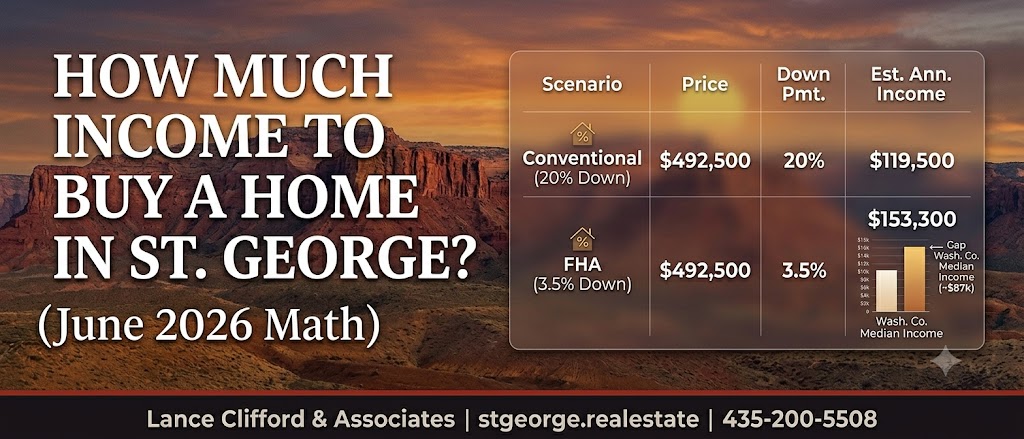
The question behind half the phone calls I get is some version of this one: how much do we actually need to make to buy a home in St. George? So let me answer it with real numbers instead of a shrug. Based on June 2026 sales data from our local MLS, the median home in St. George sold for $492,500. At the current 30-year mortgage rate of 6.58%, a buyer putting 20% down needs a household income of roughly $119,000 a year to carry that home comfortably under the standard lending guideline. Put down 3.5% on an FHA loan instead and the number jumps to about $153,000, because you are borrowing more and paying mortgage insurance on top of it. Those are the headline figures. The rest of this post walks through the math line by line, what changes the number in your favor, and the programs that help if the target feels out of reach.
What homes actually cost here right now
Start with the market itself, because the income question is really a price question. In June 2026, St. George recorded 212 closed sales with a median sold price of $492,500. Single family homes, which made up about 80% of those closings, ran higher at a $540,000 median. Homes sold in a median of 35 days, quicker than May's 41, even though active inventory grew to 1,027 listings, the highest count in the past six months. Sellers on average got 98.2% of their asking price. More homes to choose from and faster sales at near asking is not a market that is crashing or spiking. It is a market that has settled into a rhythm, which for a buyer means you have selection without much room to lowball.
I keep current figures updated every month on my St. George market summary page if you want to check how these numbers have moved since this post went up.
The math, line by line
Lenders have used the same rough guideline for decades: your total monthly housing cost, meaning principal, interest, property taxes, and insurance, should stay at or under about 28% of your gross monthly income. Plenty of buyers get approved above that line, especially with low other debts, but 28% is the honest place to start because it leaves room to actually live.
Here are the assumptions in every row of the table below, so you can check my work. Mortgage rate of 6.58%, which was Freddie Mac's national 30-year average for the week of July 23, 2026. Property taxes at 0.37% of the purchase price per year, which is the median effective rate St. George primary residences actually pay. Homeowners insurance at $125 a month, a little above the Utah statewide average of $1,261 a year since these are larger homes. The FHA column assumes 3.5% down with the 1.75% upfront mortgage insurance premium rolled into the loan and the 0.55% annual premium paid monthly. No HOA dues are included, so if you are shopping communities with an HOA, add those on top.
| Purchase price | 20% down: monthly payment | Income needed | FHA 3.5% down: monthly payment | Income needed |
|---|---|---|---|---|
| $400,000 | $2,288 | $98,000 | $2,928 | $125,500 |
| $492,500 (June median) | $2,788 | $119,500 | $3,577 | $153,300 |
| $540,000 (single family median) | $3,045 | $130,500 | $3,910 | $167,600 |
| $600,000 | $3,369 | $144,400 | $4,330 | $185,600 |
Two things jump out of that table. First, the down payment matters as much as the price. The same $492,500 house needs $119,500 of income with 20% down and $153,300 with 3.5% down, a difference of almost $34,000 a year, because the smaller down payment means a bigger loan plus mortgage insurance. Second, none of these numbers are close to the Washington County median household income, which the Census Bureau put at $86,983 in its 2024 survey. That gap is real and I am not going to pretend otherwise. It explains why so many of my buyers are arriving with equity from a home sale in California, Washington, or along the Wasatch Front, and why local first-time buyers lean hard on the programs below.
The costs people forget to count
Property taxes are the pleasant surprise in this market. Utah exempts 45% of a primary residence's market value from taxation, so you are taxed on just 55% of what the home is worth. The result is that the median St. George homeowner pays an effective rate around 0.37%, about $1,813 a year on a typical home. Buyers coming from Texas, where effective rates run north of 1.5%, sometimes ask me to double-check the number because they assume it is a typo. One caution: that exemption only applies to a primary residence. Buy the same house as a second home or a rental and your tax bill roughly doubles, which matters if you are buying here ahead of a future retirement.
Insurance is the other line that surprises people, in a good way. Utah's average homeowners premium of $1,261 a year is among the lower figures in the country, and we do not carry the hurricane and wildfire surcharges that have wrecked budgets in Florida and parts of California. HOA dues are the line that cuts the other way. Many of the newer communities here, and nearly all condos and townhomes, carry monthly dues that can range from modest to several hundred dollars, and lenders count every dollar of them against your 28%.
If the number looks out of reach
There are more levers here than most buyers realize, and some of them are specific to Utah.
Utah Housing Corporation's FirstHome loan is the big one for first-time buyers. It carries the lowest rate of the state's programs, requires a 660 credit score, and in Washington County it works for households earning up to $118,000 for one or two people, or $135,700 for three or more, on homes up to $635,300. Notice something about those limits against my table: a two-earner household right at the $118,000 cap fits the income needed for a median-priced home with a solid down payment. These limits were set with markets like ours in mind. Utah Housing also offers down payment assistance as a second loan of up to 6% of your first mortgage, capped at $27,500, which can cover most of an FHA down payment and closing costs. The assistance is not free money, it is a loan you repay, and the deferred version accrues 3.5% simple interest until you sell or refinance. I tell buyers to treat it as a bridge, not a discount.
The loan limits themselves are roomy in 2026. FHA will lend up to $607,200 on a single family home in Washington County, and conventional loans conform all the way to $832,750, so financing structure is rarely the constraint below the luxury tier.
Price is the other lever. Townhomes and condos regularly close well under the single family median, and for lock-and-leave buyers they are often the better fit anyway. The Hurricane Valley, fifteen to twenty minutes east, continues to offer more house per dollar than St. George proper, which is exactly why so much of the new building is happening out there. And new construction deserves a look even for tight budgets, because builders here are still offering rate buydowns that can pull your effective payment below what a resale at the same price would cost.
What lenders actually look at
The 28% guideline is a planning tool, not the law. What a lender actually underwrites is your full debt-to-income ratio, your credit score, your down payment source, and two years of income history. Buyers with no car payments and no student loans routinely get approved with housing costs pushing 35% of gross income or more. Self-employed buyers, and I work with a lot of them here, need two years of tax returns that show the income they are claiming, and every write-off that helps in April hurts at the mortgage desk. If you are a year out from buying, the cheapest move you can make is getting your credit score over 660, then over 700, because pricing improves at each step. And if you own a home now, your real buying power is your equity plus your income, not your income alone. Sellers can get a read on that first piece on my selling page.
Qualifying for the payment and deciding the payment is worth it are two different questions, and plenty of people who clear the income bar here still do better renting for another year or two. I ran that comparison line by line with September 2026 rents, the $520,000 Washington County median and Freddie Mac's 6.95 percent average, and the month-to-month gap came out close to $1,000. Read the buy versus rent breakdown.
Frequently asked questions
Can I buy a home in St. George on $80,000 a year?
Yes, with the right structure. At $80,000 with 20% down, the math supports a purchase around $320,000, which in this market points at townhomes, condos, and some smaller or older single family homes, with more options in Hurricane and Washington. A larger down payment, a co-borrower, or a builder rate buydown all stretch that number further.
How much is the down payment on a $500,000 home in St. George?
It depends on the loan. FHA requires 3.5%, which is $17,500. Conventional loans start at 3% to 5% down for qualified buyers, and 20%, or $100,000, is the threshold that removes mortgage insurance. Utah Housing's assistance loans can cover up to $27,500 of down payment and closing costs for eligible buyers, so the cash barrier is often smaller than people assume.
What credit score do I need to buy a home in Utah?
FHA financing is available in the low 600s with many lenders, Utah Housing's FirstHome program requires 660, and its Freddie Mac option requires 680. Above 740 you are getting the best conventional pricing. The score affects your rate more than your approval, and on a $400,000 loan even a quarter point of rate is worth roughly $65 a month.
Are there first-time home buyer programs in St. George?
Yes. Utah Housing Corporation's FirstHome loan serves first-time buyers in Washington County earning up to $118,000 for a household of one or two, or $135,700 for three or more, on homes up to $635,300, and it can be paired with down payment assistance up to $27,500. Several of its other programs are open to repeat buyers as well.
Do condos and townhomes need less income?
Usually, but check the dues. Attached homes close well below the $540,000 single family median, which lowers the loan. The offset is that HOA dues count toward your housing cost, so a $300 monthly fee cancels out roughly $47,000 of loan amount at current rates. Run both numbers before assuming the condo is the cheaper path.
Will waiting for lower rates change the income I need?
Some, but less than people hope. If rates fell a full point to 5.58%, the income needed for the median home at 20% down drops from about $119,500 to roughly $108,500. Meaningful, but a price increase of 5% while you wait would claw most of it back, and lower rates historically bring buyers off the sidelines and push prices up. If the payment works today, waiting is a rate bet, not a plan.
Run your real numbers
Tables like the one above get you in the neighborhood, but your actual buying power depends on your debts, your credit, your down payment, and which of these programs you qualify for. I have spent 13 years selling real estate here watching what buyers at every income level can actually get done in this market, and the first conversation costs you nothing. Call me at 435-200-5508, or send me a note here, and we will figure out what the numbers look like for you. If you want to see what is on the market while you think it over, start with my St. George homes for sale page.